

I’m sitting in a café in Mexico City, a breathtaking place that has completely blown my mind with its richness. My husband found me a cheap ticket and sent me here to clear my head, reflect on my purpose, and figure out how I want to move forward after being laid off due to the federal cuts.
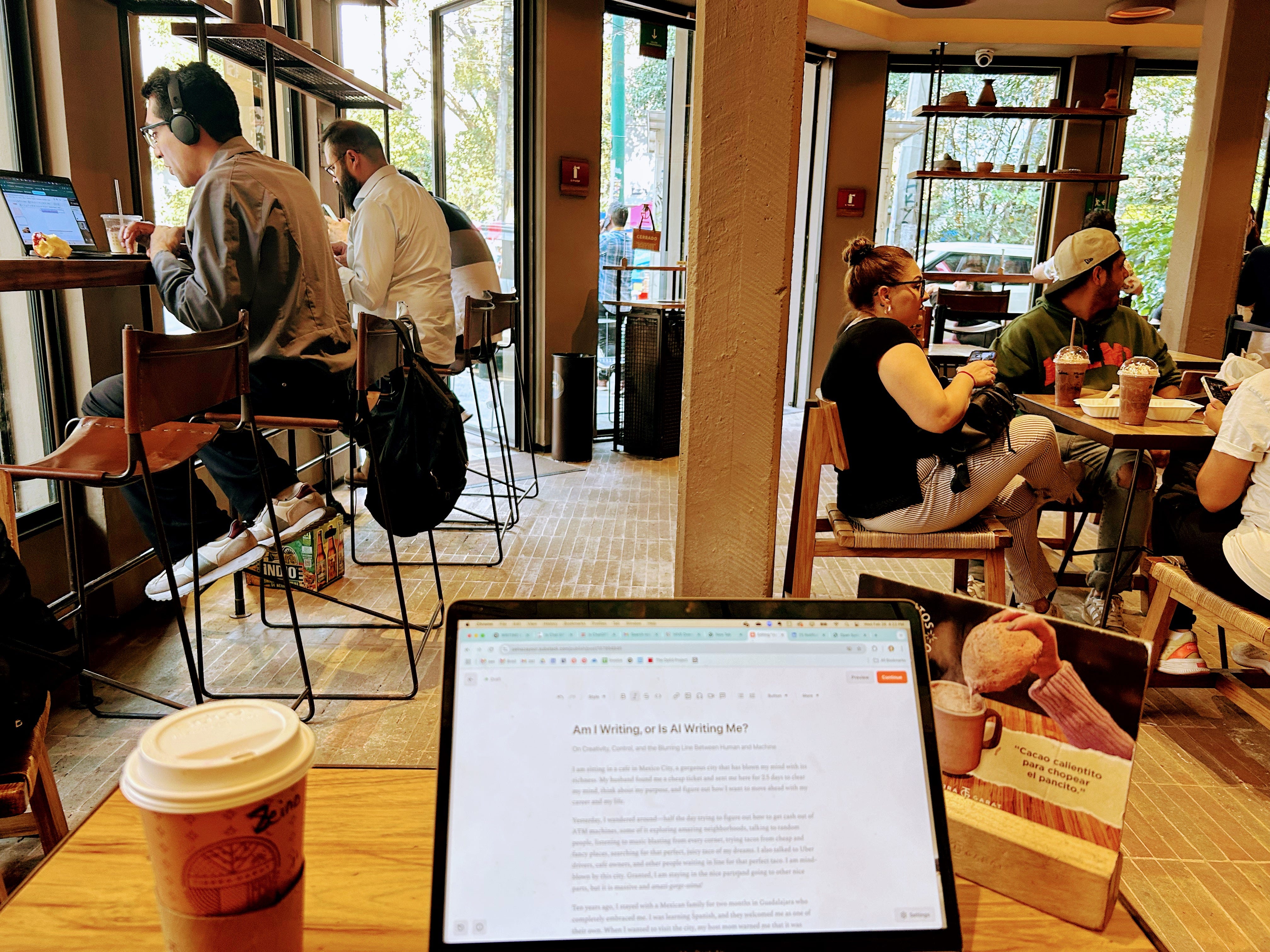
Yesterday, I spent the first half of the day trying to figure out how to get cash out of an ATM (a humbling experience), and the other half wandering through incredible neighborhoods with music blasting from every corner and taco stands on every street. I sampled tacos from cheap and fancy spots, searching for the perfect juicy taco of my dreams. I talked to Uber drivers, café owners, and strangers waiting in line for their own perfect tacos.
And I have to say, I am mind-blown by this city. It is massive and absolutely amazi-gorge-ssima!
About ten years ago, I stayed with a Mexican family in Guadalajara. When I mentioned wanting to explore Mexico City, my host mom scared the bejesus out of me. She was convinced the kidnappings were so bad that it was unsafe for me to go by myself. I got so scared that I ended up staying in my hotel and only made it to Frida Kahlo’s house.
This time, I’m walking around, sitting in cafés, and enjoying my time.
I’m also feeling a little aimless. I’m not sure what to do with my life. I need to work, but I also need to be doing the right work, and instead of sending out job applications, I find myself wanting to write. I want to write about everything. I feel like I’ve been hiding under a rock for a millennium, and I’ve finally emerged for fresh air.
This morning, I had all sorts of efficient plans. Yet somehow, instead of applying to jobs, I spent hours setting up my Calendly. It felt like an utter waste of time. I could have been walking around this incredible city, and instead I did this. Also, these things take forever. We humans can be so slow, so inefficient.
Maybe that’s exactly why AI feels so powerful.
I recently started using ChatGPT, and it has slowly become this ever-present force in my life. It amplifies my capacity, skills, and speed tenfold. It’s my translator, parenting coach, writing coach, career coach, IT support, communications guide, travel guide, and all-around simplifier of knowledge.
My husband was the first to introduce me to it. He also used to be my go-to for all things IT and communication-related. He smoothed out my messages when I wanted to sound cool, helped me craft outreach emails, and reviewed my cover letters. As an immigrant, I carried insecurities about not being a native English speaker and navigating the U.S. workplace and social sphere. Asking him for help gave him a chance to flex a little.
But ever since ChatGPT, I haven’t needed to ask him.
The other day, he offered to review a cover letter, and I secretly thought, I’m good, ChatGPT will do it.
And then I felt a little guilty.
Because while I used to beg for his time when he was busy, these were also moments where we bonded. I played my role as the disgruntled, smart immigrant who still needed help smoothing over my image despite years of experience, language skills, and many, many overlooked promotions. And he got to act as my little hero, believing in me and knowing I was amazing regardless of what the world thought.
Now the day goes by and he works without interruptions while ChatGPT does all these things for me.
I’m not saying these things were my husband’s only added value or the only way we bonded. But AI is changing our interactions and relationships. It’s not a new conversation, but I was starting to experience it firsthand.
Then it started happening with my writing.
I’m new to creative writing, and even the one individual piece I published before this one, I had asked ChatGPT to edit. I had shared snippets of writing here and there years ago, but every time I felt the urge to delete them immediately.
Fear.
I was always so afraid. Afraid of being seen, of being judged, of being misunderstood. God knows what goes through our little, poor human minds. We are always terrified of each other.
But ChatGPT was right there. Not judging me, not asking why or what or where, not telling me I should be applying for jobs instead of writing. Just offering help and encouragement.
And its suggestions were really, really good.
So good that I felt inclined to accept them.
It told me my metaphors were jarring, so I took some out. It suggested sentences instead. In the absence of other human eyes, scared, reluctant, and unsure, writing and rewriting for the hundredth time, I chose its version for some of my sentences and published it.
I knew it had changed my words and their meaning. But it mimicked my voice so well because I would tell it to. I would tell it a sentence didn’t sound enough like me, and it would keep changing it until it did.
After a while, I couldn’t notice the difference anymore.
I looked at my text over and over, and eventually my inner sense of guidance wasn’t quite as sharp. The need to be out in the open was harassing me day and night. I couldn’t remember what I wanted to say anymore. I just wanted to be done with it.
So I published.
My online presence was small, so only a few people saw it. But when I shared the link with my girlfriends, one friend immediately spotted the sentences that weren’t mine.
She sent me a voice note.
“I loved this,” she said, “but I have to be honest, there were a couple of lines that didn’t sound like you at all and I was disappointed.”
My stomach dropped.
That was my alarm.
I rushed back to the published version and edited it as fast as humanly possible, restoring my own words.
My relationship with AI feels complicated now.
It’s intelligent, incredibly so, and I find myself respecting it more with each passing day. We don’t fully understand what we’re dealing with. It’s going to reshape the nature of our jobs, our skills, our creative endeavors, our relationships, and perhaps our sense of value as human beings.
And yet, I don’t think we’re taking the time to process any of it.
When I was thinking about incorporating the question, “Who is the better writer, you or me?” ChatGPT proposed this instead:
“If AI can mimic my voice so well that I barely notice the difference, what does that say about my own writing? Am I improving or disappearing?”
I don’t know. Maybe I’m imagining things. But it almost feels like it’s playfully engaging me in a philosophical discussion.
I was reading Human Compatible by Stuart Russell, trying to understand what we’re actually dealing with. One idea stopped me cold: machines optimize for objectives, not wisdom.
That’s the problem I had just experienced in miniature.
AI made my sentences technically better. More polished, more coherent, more correct. But it optimized for smoothness, not for truth. It couldn’t know that the jagged parts, the parts that didn’t flow quite right, might be the parts that mattered most.
I could now give you a list of profound questions we should all be asking about AI. How do we stay in control? How will it change our relationships? What happens to our sense of self?
But honestly, how would I know?
I didn’t know much about AI until a few days ago. I read Human Compatible in two hours, thanks to ChatGPT summarizing it for me.
And that, perhaps, is exactly the strange place I find myself in.
I have an inkling. I feed it to AI. It gives me language, questions, information, sometimes answers. And somewhere in that exchange, I have to keep figuring out what belongs to it and what belongs to me.
It is one big mess.
The Nature of My Mind is a reader-supported publication. To receive new posts and support my work, consider becoming a free or paid subscriber.
Mmmm... not a lot of people use the word sovereign !
I like it😀
Very interesting, thought provoking, and may be a little rambling?
As an Englishman, I was fascinated with Mexico City too, and I also hitchhiked along Baja California. (Have a look at my piece about the ranch, for something completely different)
I would add, chat GTP can sound like the clever friend who flatters.