

Côte d’Ivoire was the first West African country I ever lived in. I moved there with my husband, who had a fellowship at the Ministry of Planning and Development. I’d never set foot in an African country before, and Abidjan was wild. The markets were bursting with energy, music blasted from every corner, people dressed in bright colors. People spoke loudly and laughed loudly.
It was also overwhelming for me. I spent more time at home than out. There were army checkpoints, barrages, and a subtle but unmistakable tension in the air that reminded me of Lebanon and its civil war.
On our first night, coming from the airport, we were stopped by tense soldiers. I smelled blood. Well, not literally. But I knew that feeling. I had grown up around war, and something in my body was telling me that something wasn’t right. Call it PTSD. After that encounter, I avoided going out alone at night. My husband thought I was overreacting. Maybe I was. But my PTSD wouldn’t listen.
And yet, every time we went out, life was electric. Food, laughter, and coupé-décalé music spilled into the streets. You couldn’t help but move with it and feel the explosiveness of joy around you.
Not long after, I landed a short-term gig in neighboring Mali, so I crossed the border. My husband was going to follow me soon.
Mali, to me, was the opposite of Côte d’Ivoire. If Côte d’Ivoire was fire, Mali was water. People moved slowly. They spoke in soft voices. They drank tea on sidewalks with reverence and ritual. The energy was gentler, easier on my nervous system. That was 2013, before the country slid deeper into unrest and conflict. Looking back now, knowing what would follow, it feels surreal. At the time, I experienced Mali as one of the softest, most peaceful places I had ever been.
I had never imagined two neighboring countries could feel so different. That experience taught me that whole cultures can have a collective nervous system, a shared tempo and rhythm. I began noticing it everywhere I went. Some places I vibed with instantly, others left me restless.
The most profound music moment I had in Mali came when my husband finally visited. His friend took us to a small, dimly lit café. I wasn’t expecting much, if I’m honest, I’d been missing Ivorian food, and Mali hadn’t yet impressed me in the cuisine department. The sun had just gone down, and Nouhoum mentioned someone would be playing music. I didn’t ask for details.
Then it began.
At first, I didn’t even know where the sound was coming from. I couldn’t see the musician or the instrument. But the moment I heard it, my whole body froze. It felt like the music wasn’t of this world, as if it were descending from the heavens. My heart leapt in my chest. I turned to Josh, stunned. Is this real?
I sat in complete awe, mesmerized. Only later did I learn that the musician was Toumani Diabaté, one of the greatest kora players in the world. Without knowing it, I had been in the presence of a legend.
I left feeling mystified, completely captivated by the music and the instrument he was playing.
The kora.
Back home, I fell into a rabbit hole, searching for every recording I could find.
The kora is more than an instrument. Its patterns are complex and interlocking, demanding not only technical skill but also a deep sense of rhythm and memory. In its traditional context, playing it means carrying the history and stories of a community. At the heart of the griot tradition in Mali, Senegal, Gambia, and Guinea, the kora is a vessel of cultural memory.
Griots are historians, storytellers, praise singers, poets, and musicians. Their tradition stretches back to the 13th-century Mali Empire, when they served as advisors and diplomats to kings. The music, poetry, and stories they preserved form a living archive in places where much history was never written.
Traditionally, the kora was played by men from specific griot families, names like Kouyaté, Diabaté, Konte, and Cissoko. Its 21 strings, mounted on a half-gourd covered in animal skin, accompanied genealogies, epics, and historic events. While griots might also play the balafon (wooden xylophone) or the ngoni (plucked lute), the kora became their emblem.
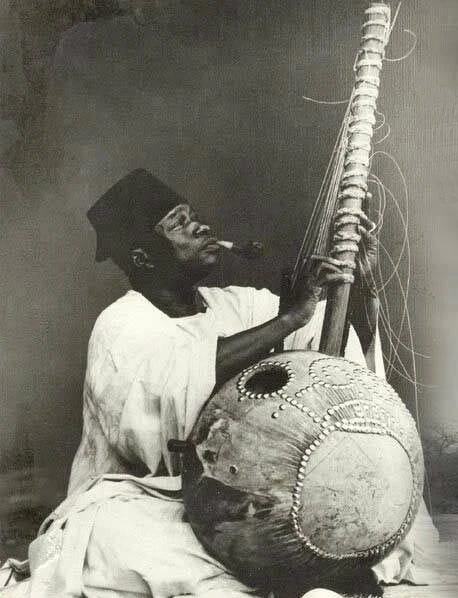
This music belongs to the Mande tradition, a centuries-old repertoire known as jeliya, passed down through griot lineages. In this tradition, instruments are not just for melody, they are carriers of history and ancestral stories. The kora, balafon, ngoni, and even the guitar share the same melodic phrasing, modal scales, and cyclical rhythmic patterns.
Some musicians play both kora and guitar, and the two work beautifully together. The guitar can echo the kora’s rolling melodic lines and provide harmonic grounding, while the kora creates layers and textures the guitar cannot match. This is why Ali Farka Touré’s guitar style fits so naturally into the same tradition, even though his instrument came from outside Africa. If you haven’t heard of him, you’re missing something extraordinary. His playing draws directly from the modal scales, repetitive riffs, and call-and-response phrasing of traditional Malian music, especially the Songhai tradition of northern Mali. His son, Vieux Farka Touré, carries that sound into new territory, blending tradition with modern influences and international collaborations. See Vieux Farka Touré et Khruangbin and the Toure Rachel Collective by Vieux and Idan Raichel.
Mali is home to some of the greatest kora players in the world. Beyond Toumani Diabaté, widely known as the king of the kora, his son Sidiki Diabaté has brought the instrument into contemporary pop and hip hop.
Other amazing artists include Ballaké Sissoko who has created duets that are intimate and hypnotic. Kadija is my favorite of his.
Boubacar Traoré also featured above, is an extraordinary guitarist and singer whose music blends blues and Mande traditions, sometimes accompanied by the kora in hauntingly beautiful arrangements; and Sona Jobarteh, the groundbreaking Gambian virtuoso, is the first professional female kora player from a griot lineage.
The collaborations are endless and exquisite. The guitar collaborations between Ali Farka Touré and Toumani Diabaté, and later between Toumani and Ali’s son, Vieux Farka Touré, are treasures of global music. Malian music is a river that keeps on giving.
Ultimately, Côte d’Ivoire gave us coupé-décalé, its own electrifying genre, while Mali gave us many of the world’s greatest kora players, each carrying the pulse of their people.
In both places, music is inseparable from the culture, it holds their histories, their stories, their blood, their nature, their pace. It reflects them, and they reflect it.
Still we find ourselves attracted to certain type of music that speak to us. We may not always know what it’s saying, but we react to it. It may come from different genres, different corners of the world. It calls, and we respond. It’s a most curious thing. What is it that calls us, in music, in dance, in art, in writing, in all things beautiful? In the smile of a stranger, in the glance we share with someone. Our bodies and our beings react and we answer: yes, we hear you. Here we come.

Thank you for reading the Nature of My Mind.
Subscribe for more!
Wow! Thanks so much for introducing me to this incredible music. I've never heard of this instrument either but as a guitarist I can definitely appreciate the amazing level of talent this would take to play.