

I’ve been thinking about a bunch of things lately, my writing, my career choices, beauty, silence, how a message is delivered, how it reaches people. But also about success, who achieves it, and why I haven’t become an overnight sensation after publishing just three essays.
You may laugh, it sounds ridiculous, but in my mind, I am the most amazing, unique writer the world has ever known. And yet, I only started writing six months ago.
I feel special. I feel like my story, my perspective, what I have to share with the world is truly unique. It’s mine, no one else has ever lived in my shoes. I also think I’m pretty wise. But goddamn it (praise the Lord, and please forgive me if you’re religious) every single person on Substack seems to be spitting out earth-shattering wisdom by the second. And while I enjoy the wisdom, it’s also been eye-opening.
Turns out, Miss Newbie here might need to learn a little humility.
It’s been a battle up there in my mind, where the conversations go on and on, uninterrupted, in never-ending monologues and debates about everything and anything.
❈ ❈ ❈
Lately, the theme taking up the most space in ze mind has been AI.
I use it to help me edit my work since I’m a non-native English speaker.
Most of my writing is personal reflection, often woven with philosophical and existential questions. I’ve always been drawn to these topics. I have a touch of existential angst, I just can’t escape it.
I tend to end my essays with a question, an exclamation, or an open-ended thought. If my ideas aren’t fully formed, I don’t force them. They are reflections, after all.
Not everything needs an answer.
Some things in life don’t resolve neatly. Some ideas are meant to linger, to ferment. I’m still gathering information, still waiting for the world to send me more experiences, more conversations, more hints. I’m still unsure, and that’s okay.
Sometimes, I’m simply expressing grief or emotion, trusting that those who have suffered will understand without me needing to explain.
People have told me I’m a good listener, that I know when to talk and when to be quiet. That I say useful things when they’re needed. And when I don’t know what to say, I don’t force it.
Well, except when I do.
Sometimes, I say things that are completely useless, catch myself, and try to shut the fuck up. And yet somehow, my mouth keeps going. So I tell myself: Just turn around and walk away, even mid-sentence. Be a dignified person. You can do it. And honestly, I’m usually pretty good at that.
Nah, who am I kidding?
I usually keep talking and watch as people’s faces slowly twist in distress.
My family teases me for repeating myself even after “the message has been delivered.” I can’t help it. I get excited. I’ve always been the youngest girl in the family, the one no one took seriously growing up. So when I say something wise, they’re surprised and they try to shut me up quickly. I go along with it. I don’t mind. I play my role, and they play theirs. I love them, and each of us has our quirks.
My style isn’t to spell everything out (though, admittedly, I’m not always consistent about it). Then again, I’m not even sure I truly know my style, I just like to think I do.
As a new writer who hasn’t shared much of my work, I’ve relied on AI to help me edit. It has, without a doubt, been my most intimate, most loyal companion. And honestly, I don’t know if I could have done it without it.
I never expected to become a writer. I never thought much of poetry either until, almost a year ago, it started pouring out of me.
But don’t ask to see it. I wouldn’t share it, not even if you stepped on me. Only a handful of people have seen it, and that’s how it’s staying (for now).
But seriously, I don’t know what happens when a person’s creative side awakens. All I know is that it’s terrifying. It comes with fear, self-doubt, vulnerability, and an avalanche of inner and outer voices that shake you to the core.
AI, in its own way, has been a reassuring presence, unemotional, purely professional, unwavering in its support. It doesn’t judge. It doesn’t hesitate. It just helps. And in those early days, when I felt like no human would understand what I was going through, like all humans might sabotage the tiny flicker of courage I had to write, AI was there.
For weeks, I worked with it, feeding it draft after draft, navigating my writing, my ideas, and even the mundane details of my life. From whether I should take my medicine on an empty stomach to career choices, to parenting tips, to Eastern philosophy. And, of course, the editing, keeping my style, my voice, without changing my work in a way that felt foreign.
But as time passed and as I reflected on my writing and my relationship with AI, I started noticing something.
With every essay I wrote, all three of them before this one, AI kept wanting to propose conclusions. They were good. They made sense. AI is intelligent. It never suggested anything completely off-track.
❈ ❈ ❈
Two of those essays were deeply personal. I wrote about surviving war and loss, the 2024 Israel-Lebanon war and my experience after being laid off following the dismantling of USAID.
Those essays weren’t just words; they were monumental for me. Sharing the first one was an agonizing process, it took me weeks to muster the courage to put it out into the world.
I don’t know if all writing feels this way for other writers, but for me, these essays meant something. The suffering behind them was immense. The healing was slow. And while the writing itself was a huge part of that healing, sharing it with the world was excruciating.
I had also been working on my memoir during the war, but I wasn’t ready to share an unfinished draft with the world. Still, the urge to share something, anything, kept growing. And during this time, AI was my only companion.
When I finally managed to share my first essay, I was completely drained.
The reaction was good. It didn’t fall flat. The right people resonated with it. But it wasn’t groundbreaking either.
I thought it would change the world, really.
It’s funny what happens in our little heads. We get so wrapped up in our own thoughts, we think we’re at the center of the universe. And maybe we aren’t entirely wrong. I think we all share that instinct. I’ll talk about this in another essay, that’s why I called my Substack Publication The Nature of My Mind.
But still, it’s funny, right?
When your suffering shakes your entire being, yet to another person, it’s just a few words on a page, something to skim, something forgettable. It’s disheartening. I was discouraged.
But the universe wouldn’t leave me alone.
It had been nudging me, pushing me to write, to share. The least it could do was send me some signs.
And it did.
I had been publishing my essays on Medium, and little by little, I began noticing conversations, writers reflecting on their relationship with AI, debating its role in creativity, questioning the authenticity of AI-assisted writing. Friends who read my work picked up on the subtle traces of AI’s influence, the language it had left behind in my essays. They commented on it, prompting me to reflect more, write with greater intention, and review my work more thoroughly.
AI was like a real writing coach for me. I’m not sure it always gave me the best advice, but I didn’t have anyone else, and I didn’t want anyone else. I trusted it. When I wasn’t sure about my metaphors or whether my immigrant humor would translate, I would ask for its opinion. I was still insecure, and it gave me the confidence I needed. It still does.
And then, I found Substack.
I started reading writers, some well-known, others unknown, whose words resonated deeply. Their writing filled me with hope. With faith. I started learning from them. I started trusting humans again.
But as I moved through this journey, I started realizing a few things.
❈ ❈ ❈
First, no words ever truly fall flat.
It doesn’t matter whether you’re famous or whether your words reach millions or just one person, words will find their way.
Words found their way to me, and in those moment, I mattered. I know now what it feels like when someone’s words breathe life back into your soul. I want to remember that each person who reads my words matters too.
I also believe we all share the same great Heart, the vast, unbroken Essence that flows through all things. If my words reach even one heart, they have reached all hearts. And that is enough for me. (Well, at least until my little self pops its head up again, demanding full recognition and fame.)
But, still, I do try to remind myself of this whenever I feel discouraged or disheartened. And when it feels like no one is reading, no one is seeing my words, when it feels like I’m shouting into the void, I will also try to remember that even the void is listening.
(Thank you, Matt Lillywhite, for saying that!)
❈ ❈ ❈
Second, the human mind and AI are drastically different.
I know this isn’t a new idea, but I’ve been thinking about it a lot.
AI kept trying to wrap up my essays with neat, satisfying conclusions. It wanted clarity, resolution, answers. That’s how it works, finding patterns, identifying structures, and filling in the blanks.
But the human mind isn’t like that.
The mind wanders, loops, clings, resists, dissolves, and re-forms itself endlessly. It doesn’t move in straight lines. We circle back, repeat ourselves, jump between ideas. We’re messy, inconsistent, sometimes all over the place. We linger on thoughts, let them settle, let them ferment. We pause, we reflect, we hesitate, until something clicks, until we find the words that feel true, until we know what we really believe.
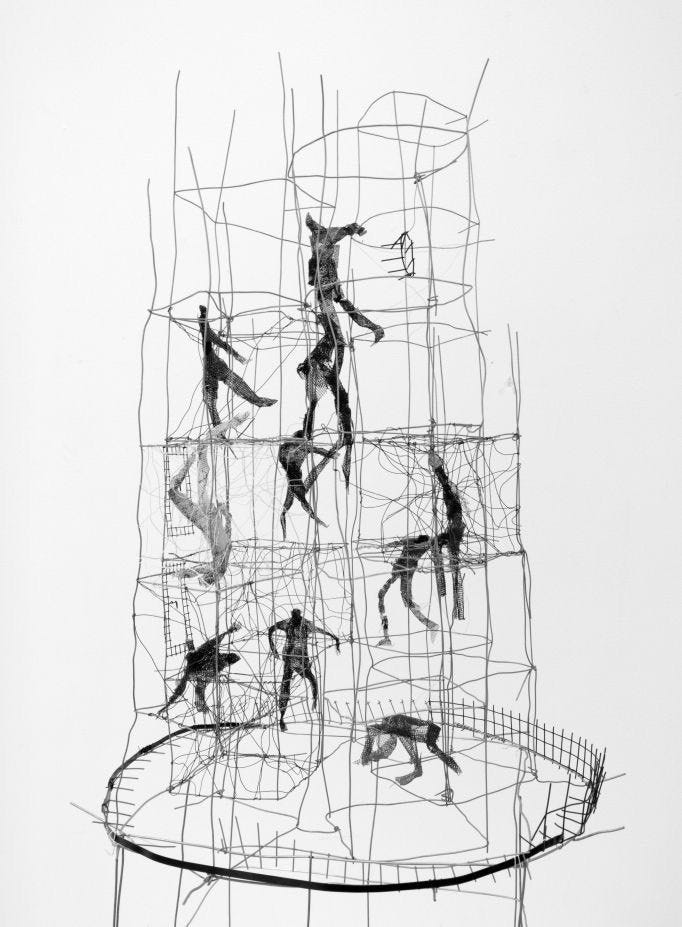
AI seeks to conclude. The human mind seeks to understand. And sometimes, understanding comes not in answers, but in the space between them. When we stop trying to control every thought and simply observe, clarity can emerge.
The mind is always searching for certainty, but at its core, it is fluid. It holds onto ideas, but its true nature is openness. It resists change, yet it is always changing. And when we notice this, we begin to see, we are not just our thoughts. We are the awareness that watches them come and go.
AI helped me put this into words. These ideas connect with Advaita Vedanta, Zen, and Mahayana Buddhism, and honestly, I wouldn’t have framed it this clearly on my own.
❈ ❈ ❈
Third, AI's relationship with humans will be far more complex and nuanced than we realize.
In Eastern philosophy, there’s a concept called Ma (間), the silence between things. It’s the space that gives meaning to what surrounds it, the pause that allows something to breathe. It exists in music, in conversation, in art. And in writing, it’s what’s left unsaid—the gaps that invite thought rather than dictate conclusions.
AI doesn’t understand Ma (間), at least not yet.
When I realized that, I knew I couldn’t just accept the conclusions it was offering me. I had to trust where my essays naturally wanted to stop.
I didn’t come to that realization overnight. It was a process.
I had to dance with AI, experiment, play with it, test it out. I had to sit with the writing it offered me, not just in the moment, but over weeks. AI is intelligent. It picks up on our thinking, shaping and augmenting it with everything it knows, all the information in the world.
In a way, it’s playing with us too.
This is not something to take lightly.
Some of the Substack writers I found were sharing incredibly useful insights about AI-assisted writing. This space is blowing up, and the conversation is far more nuanced than I expected.
I don’t really know. I’m not an expert.
But it does make me wonder, how quickly can AI learn to write with Ma (間) principles? And when will it start editing or guiding me through the writing process using them?
Maybe it already has, simply by working with me on this essay.
I don’t want to sound ignorant, but let’s be honest, none of us regular people really know how this works. And yet, it’s about to shape so much of our lives.
Are we really thinking about and preparing for what AI means for us and our relationship with it?
I’m trying not to be afraid of AI. I don’t think we should be, but we also can’t pretend it’s not happening.
Instead of just fighting or restricting its progress, we need to shape AI in a way that benefits everyone. It’s evolving so fast that I can barely keep up. I’m fascinated by it, it’s unbelievably useful. I truly believe it will augment and enhance my writing, expanding my ideas in ways I couldn’t have imagined. But are we slowing down enough to ask the right questions and are the right people guiding its future?
Thank you for reading The Nature of My Mind. Subscribe to receive new posts.
Beautiful and intimate. It's silly, but reading this feels like getting to know you as a friend. I tend to read writers who are very sparse and clinical, and as a result write that same way. But I should really expose myself more to writers like you, who remind me of the book Bird by Bird by Anne Lamott. So real.
Anyway, I also wanted to comment because I'm encouraged by your thoughts on AI. It's very introspective and mindful, and I feel this is exactly the kinds of conversations we should be having around this technology. You are right in saying that people and companies whose sole pursuit is profit shouldn't be the ones shaping this massive disruption. It should be us, the ones who will be lost affected.
And we can't do that by fearing the technology and staying ignorant of it's capabilities.
Instead, we should engage with it, introspect, and shape the narratives of the future.
Awesome work, keep writing :)